
Guide
VO2 max workout: how to increase your VO2 max
VO2 max is a measure of aerobic fitness, and it responds to training. Here is what raises it, a workout to do today, a weekly plan, how long change takes and how to track it. Every figure comes from the study it cites; where an idea is our own, we say so.
Updated
In short
- In a controlled trial, hard intervals raised VO2 max more than the same work done easier. Across trials they have a small edge over steady training, and both work.
- One tested VO2 max workout is the Norwegian 4x4: four rounds of 4 min at 90 to 95 % of max heart rate, with 3 min of easy movement between them.
- In the 4x4 trial, 3 sessions a week for 8 weeks raised VO2 max by 7.2 %.
- If you have a heart condition or other health concerns, talk to a doctor before hard intervals.
What is VO2 max, and why does it matter?
VO2 max is the highest rate at which your body can take up and use oxygen during exercise, in milliliters of oxygen per kilogram of body weight per minute (mL/kg/min). It is a common measure of aerobic fitness. Some studies report peak VO2 (VO2 peak), the highest value reached in a test, instead.
Fitness goes with health. A pooled analysis of 33 cohort studies, with about 103,000 people in the death analysis, found that each 1-MET higher aerobic capacity (about 3.5 mL/kg/min) went with a 13 % lower risk of death from any cause and a 15 % lower risk of coronary and cardiovascular events. Low fitness carried a 70 % higher risk of death than high fitness (Kodama 2009). That is an association from observational studies, not proof that training causes it.
VO2 max also falls with age, faster later in life. In 810 healthy adults aged 21 to 87, tested repeatedly over a median of 7.9 years, peak VO2 fell 3 to 6 % per 10 years in their 20s and 30s and more than 20 % per 10 years from their 70s on, at every level of reported leisure-time activity (Fleg 2005).
How to increase VO2 max: intervals or steady cardio?
Both raise VO2 max. When trials match the total work, the harder sessions come out ahead.
Hard intervals beat the same work done easier
In a trial of 40 healthy, moderately trained men, four groups did the same total work 3 times a week for 8 weeks: steady running at 70 % of max heart rate, running at 85 % (the lactate threshold), intervals of 15 s on and 15 s easy, or four rounds of 4 min at 90 to 95 %. Both interval groups raised VO2 max significantly more than the other two (P < 0.01). The 4x4 group went from 55.5 to 60.4 mL/kg/min, a gain of 7.2 %, and stroke volume, the blood pumped per heartbeat, rose about 10 % after interval training.
Keep in mind Healthy, moderately trained men, over 8 weeks.
Across trials, intervals have a small edge
A meta-analysis of 28 controlled trials in 723 healthy adults aged 18 to 45 found that, against no exercise, high-intensity intervals raised VO2 max by about 5.5 mL/kg/min and continuous endurance training by about 4.9 mL/kg/min. Intervals beat continuous training by about 1.2 mL/kg/min. Trials in people with lower starting fitness, and longer programs, showed larger gains.
Keep in mind The edge is small. Both work.
In patients, the gap was bigger
Across 10 studies with 273 patients with coronary artery disease, heart failure, high blood pressure, metabolic syndrome or obesity, intervals raised VO2 peak by 3.03 mL/kg/min more than moderate continuous training: almost double the gain. In 27 heart failure patients averaging 75.5 years, 12 weeks of intervals at 95 % of peak heart rate raised VO2 peak by 46 %, against 14 % for moderate training.
Keep in mind Patients in clinical studies. If you have a heart condition, talk to a doctor before hard intervals.
Sources: Weston, Wisløff, Coombes, Br J Sports Med 2014; Wisløff et al., Circulation 2007
Which workout is best for VO2 max?
No single workout has been shown to be best. The research points to three features:
- Time near the top. Intervals are thought to work best with at least several minutes a session at or above about 90 % of VO2 max (Buchheit & Laursen 2013).
- Intervals long enough to get there. Oxygen uptake takes time to adjust when hard exercise starts, so the first part of every interval is catch-up (Jones & Burnley 2009).
- Enough hard work. Across 37 studies in 334 healthy, inactive or recreationally active people under 45, interval programs (some with steady training too) of 6 to 13 weeks, 3 or more days a week and at least 10 min of hard work a session raised VO2 max by 0.51 L/min (liters of oxygen per minute) on average. In the 9 studies with longer intervals, the gain was about 0.8 to 0.9 L/min (Bacon 2013).
Evidence on interval length is mixed: in the 28-trial meta-analysis, its effect was small and pointed both ways, depending on the comparison.
Our reading: intervals of a few minutes at 90 to 95 % of max heart rate, adding up to more than 10 min of hard work, fit all three. The 4x4 has 16 min of hard work and was tested head to head against easier training. It is one good option, not the only one.
A VO2 max workout you can do today
The Norwegian 4x4 is the workout from the 8-week trial above. It takes about 40 min.
| Stage | Length | Effort |
|---|---|---|
| Warm-up | 10 min | Easy, building to moderate |
| Work | 4 × 4 min | 90 to 95 % of max heart rate |
| Recovery | 3 min | About 70 %, still moving, between rounds |
| Cool-down | 5 min | Easy |
With a max heart rate of 180 bpm, the work zone is 162 to 171 bpm and recovery is about 126 bpm. Fjell's rule of thumb, not a tested standard: reach the zone within the first half of each round, then hold it. If round 4 falls apart, round 1 was too hard.
Anything that lets you work hard for 4 min works: running uphill, cycling, rowing or stair climbing. For the session minute by minute, how to find your max heart rate and the common mistakes, read the Norwegian 4x4, explained.
How often to train: a weekly VO2 max plan
The research gives a range, not one answer:
- The 4x4 trial used 3 sessions a week for 8 weeks (Helgerud 2007).
- More training, fewer people left behind. In a 6-week endurance trial of 78 healthy adults, the share whose fitness did not improve beyond measurement error fell from 69 % with one 60 min session a week to none with four or five. Those who had not improved added two sessions a week for 6 more weeks, and all of them improved (Montero & Lundby 2017).
- The heart's autonomic recovery takes at least 48 hours after a hard session, and is quicker in fitter people (Stanley, Peake, Buchheit 2013).
- The WHO recommends that adults get 150 to 300 min of moderate or 75 to 150 min of vigorous activity a week, or a mix, plus regular muscle-strengthening activity (Bull et al. 2020).
An example week
This is our example, not a prescription: two hard sessions at least 48 hours apart, with easy movement and strength work on other days.
| Day | Session |
|---|---|
| Monday | 4x4, about 40 min |
| Tuesday | Easy walk, ride or jog, 30 to 45 min |
| Wednesday | Strength training |
| Thursday | 4x4, about 40 min |
| Friday | Rest, or an easy walk |
| Saturday | Longer easy session, 45 to 60 min |
| Sunday | Strength training, or rest |
Once built, VO2 max may take fewer hard sessions to keep. In a small study, 12 adults averaging 23 years raised it by 20 to 25 % in 10 weeks, then kept it for 15 more weeks on 2 or 4 days a week at the same intensity and duration (Hickson 1981). In a similar group, cutting the intensity by a third lost part of the gain, and the authors called intensity essential for keeping it (Hickson 1985).
How long does it take to increase VO2 max?
Weeks, in the studies: 8 weeks for a 7.2 % gain in the 4x4 trial, and 6 to 13 weeks in the 37-study meta-analysis. In the 28-trial meta-analysis, longer programs and lower starting fitness went with larger gains, and in the dose trial above, more sessions meant more people improved.
We know of no reliable figure for how soon your own change will show. Our suggestion: give a plan 8 weeks, the length of the 4x4 trial, before you judge it.
How to track your VO2 max
In a lab
The reference method is indirect calorimetry: a maximal exercise test with your breathing analyzed through a mask. Validation studies of wearables use it as the standard (Lambe 2025).
With Apple Watch
Apple Watch Series 3 or later estimates VO2 max from its heart and motion sensors during Outdoor Walk, Outdoor Run or Hiking workouts in the Workout app, and the Health app shows it under Heart, then Cardio Fitness. Apple says the first estimate can take at least 24 hours of wear plus several such workouts and passive measurements, that it covers 14 to 65 mL/kg/min, and that conditions or medications that limit your heart rate might make it read high (Apple Support).
In two small studies against a lab test, the estimate's average error was 13 to 16 %, either way. In 30 people it read low by about 6 mL/kg/min on average (Lambe 2025). In 19 people it tended to read high at low fitness and low at excellent fitness (Caserman 2024).
Our reading: treat it as a rough guide. Neither study tested how it follows change over time, so compare readings from similar outdoor workouts over weeks rather than one number.
Fjell does not estimate VO2 max. It coaches the workout itself, by heart rate.
Is VO2 max training safe?
Hard intervals push your heart rate close to its maximum on purpose. If you have a heart condition or other health concerns, talk to a doctor first, and if you take medication that affects your heart rate, ask how to set your zones.
In one large study, serious events were rare. Among 4,846 patients with coronary heart disease in 3 Norwegian cardiac rehabilitation centers, there was 1 fatal cardiac arrest in 129,456 hours of moderate exercise, 2 nonfatal cardiac arrests in 46,364 hours of high-intensity intervals, and no heart attacks (Rognmo 2012). The authors judged the risk low with both, but these patients trained in organized rehabilitation, not on their own.
If you are new to hard training, start with fewer rounds or a lower target and build up. Keep moving in recovery, and stop if you feel unwell.
Questions about VO2 max training
What is the best workout to increase VO2 max?
No single workout has been shown to be best. In a controlled trial, hard intervals raised VO2 max more than the same work done easier. The Norwegian 4x4 from that trial is one example: four rounds of 4 min at 90 to 95 % of max heart rate, with 3 min of easy movement between them.
How long does it take to increase VO2 max?
Studies measured gains after 6 to 13 weeks. In the 4x4 trial, 3 sessions a week for 8 weeks raised VO2 max by 7.2 %. Your rate will differ: lower starting fitness went with larger gains, and more training helped people who improved little at first.
How many times a week should I do VO2 max intervals?
The 4x4 trial used 3 sessions a week for 8 weeks, and in a small study 2 hard sessions a week kept a gain once it was built. Space hard days at least 48 hours apart, the time the heart's autonomic recovery takes. This is general guidance, not a prescription.
Can steady cardio increase VO2 max?
Yes. In a meta-analysis of 28 controlled trials in healthy adults, continuous endurance training raised VO2 max by about 4.9 mL/kg/min against no exercise. High-intensity intervals raised it by about 5.5 mL/kg/min, a small edge. Both work.
How accurate is the VO2 max estimate on Apple Watch?
Only roughly. In two small studies against a lab test, Apple Watch's Cardio Fitness estimate was off by 13 to 16 % on average, and in one it read low by about 6 mL/kg/min on average. Neither tested how it follows change over time. Our reading: watch the trend over weeks, not a single number.
What is a good VO2 max?
It depends on your age, since VO2 max falls with age, faster in later decades. For health, a pooled analysis of 33 studies found substantially lower rates of death and heart disease at an aerobic capacity of 7.9 METs or more, about 28 mL/kg/min, than below it. That is an association, not proof of cause.
Sources
- Helgerud J, Høydal K, Wang E, et al. Aerobic high-intensity intervals improve VO2max more than moderate training. Med Sci Sports Exerc 2007;39:665–671. doi.org/10.1249/mss.0b013e3180304570
- Milanović Z, Sporiš G, Weston M. Effectiveness of high-intensity interval training (HIT) and continuous endurance training for VO2max improvements: a systematic review and meta-analysis of controlled trials. Sports Med 2015;45:1469–1481. doi.org/10.1007/s40279-015-0365-0
- Weston KS, Wisløff U, Coombes JS. High-intensity interval training in patients with lifestyle-induced cardiometabolic disease: a systematic review and meta-analysis. Br J Sports Med 2014;48:1227–1234. doi.org/10.1136/bjsports-2013-092576
- Wisløff U, Støylen A, Loennechen JP, et al. Superior cardiovascular effect of aerobic interval training versus moderate continuous training in heart failure patients: a randomized study. Circulation 2007;115:3086–3094. doi.org/10.1161/circulationaha.106.675041
- Kodama S, Saito K, Tanaka S, et al. Cardiorespiratory fitness as a quantitative predictor of all-cause mortality and cardiovascular events in healthy men and women: a meta-analysis. JAMA 2009;301:2024–2035. doi.org/10.1001/jama.2009.681
- Fleg JL, Morrell CH, Bos AG, et al. Accelerated longitudinal decline of aerobic capacity in healthy older adults. Circulation 2005;112:674–682. doi.org/10.1161/circulationaha.105.545459
- Buchheit M, Laursen PB. High-intensity interval training, solutions to the programming puzzle. Part I: cardiopulmonary emphasis. Sports Med 2013;43:313–338. doi.org/10.1007/s40279-013-0029-x
- Jones AM, Burnley M. Oxygen uptake kinetics: an underappreciated determinant of exercise performance. Int J Sports Physiol Perform 2009;4:524–532. doi.org/10.1123/ijspp.4.4.524
- Bacon AP, Carter RE, Ogle EA, Joyner MJ. VO2max trainability and high intensity interval training in humans: a meta-analysis. PLoS One 2013;8:e73182. doi.org/10.1371/journal.pone.0073182
- Montero D, Lundby C. Refuting the myth of non-response to exercise training: “non-responders” do respond to higher dose of training. J Physiol 2017;595:3377–3387. doi.org/10.1113/jp273480
- Stanley J, Peake JM, Buchheit M. Cardiac parasympathetic reactivation following exercise: implications for training prescription. Sports Med 2013;43:1259–1277. doi.org/10.1007/s40279-013-0083-4
- Bull FC, Al-Ansari SS, Biddle S, et al. World Health Organization 2020 guidelines on physical activity and sedentary behaviour. Br J Sports Med 2020;54:1451–1462. doi.org/10.1136/bjsports-2020-102955
- Hickson RC, Rosenkoetter MA. Reduced training frequencies and maintenance of increased aerobic power. Med Sci Sports Exerc 1981;13:13–16. doi.org/10.1249/00005768-198101000-00011
- Hickson RC, Foster C, Pollock ML, et al. Reduced training intensities and loss of aerobic power, endurance, and cardiac growth. J Appl Physiol 1985;58:492–499. doi.org/10.1152/jappl.1985.58.2.492
- Apple. Track your cardio fitness levels. Apple Support, read October 9, 2026. support.apple.com/en-us/108790
- Lambe R, O'Grady B, Baldwin M, Doherty C. Investigating the accuracy of Apple Watch VO2 max measurements: a validation study. PLoS One 2025;20:e0323741. doi.org/10.1371/journal.pone.0323741
- Caserman P, Yum S, Göbel S, et al. Assessing the accuracy of smartwatch-based estimation of maximum oxygen uptake using the Apple Watch Series 7: validation study. JMIR Biomed Eng 2024;9:e59459. doi.org/10.2196/59459
- Rognmo Ø, Moholdt T, Bakken H, et al. Cardiovascular risk of high- versus moderate-intensity aerobic exercise in coronary heart disease patients. Circulation 2012;126:1436–1440. doi.org/10.1161/circulationaha.112.123117
Let Fjell keep time
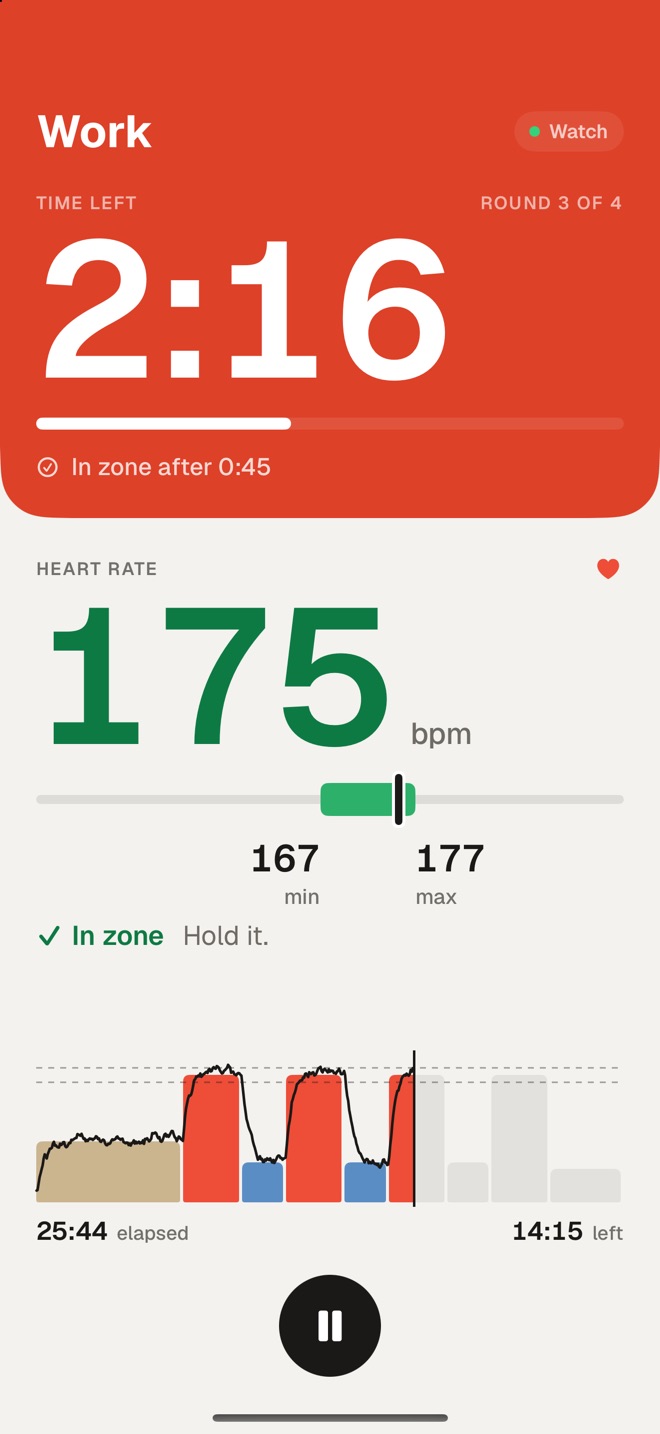
Fjell runs the 4x4 on iPhone and Apple Watch. It times every stage, speaks the cues over your music and shows your heart rate against the zone, and during each round it tells you whether you will reach the zone by halfway.

The 4x4 is hard. If you have a heart condition or other health concerns, talk to a doctor first. Fjell is not medical advice.